
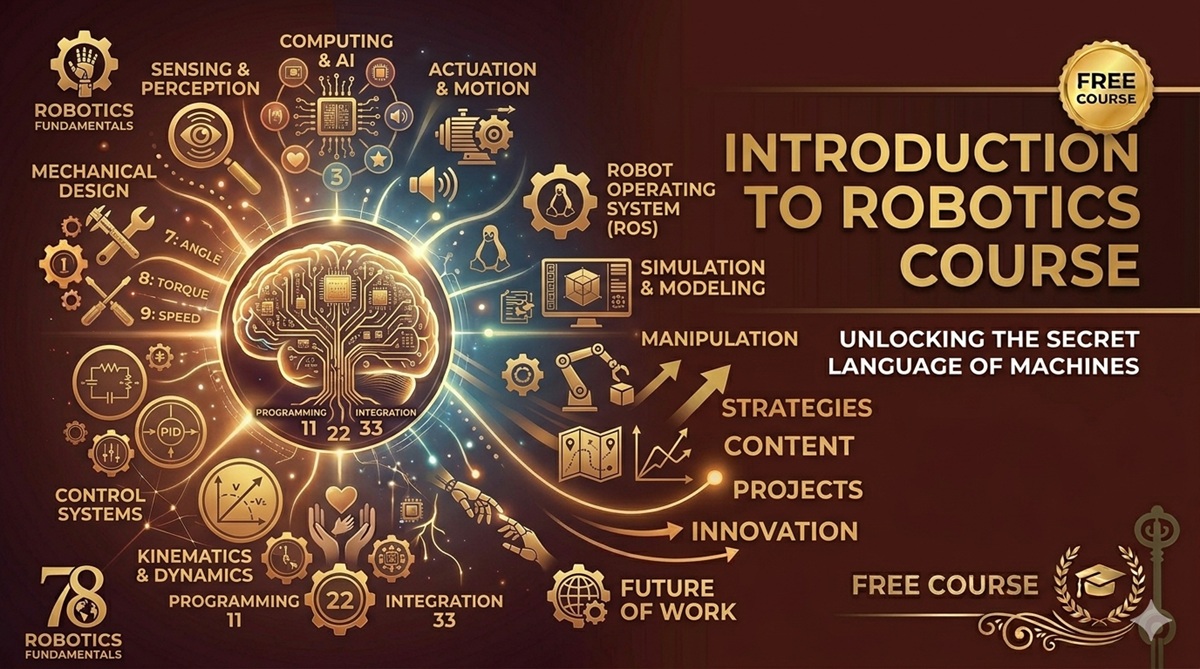
This course provides an overview of robot mechanisms, dynamics, and intelligent controls. Topics include planar and spatial kinematics, and motion planning; mechanism design for manipulators and mobile robots, multi-rigid-body dynamics, 3D graphic simulation; control design, actuators, and sensors; wireless networking, task modeling, human-machine interface, and embedded software.
🎓 Certificate Included
Upon successful completion of this course, students will receive a digital Certificate of Completion that can be downloaded and shared as evidence of their learning achievement.


The phrase “servitude,” “forced labour,” and “drudgery” all derive from the Old Church Slavonic word “robota.” As part of the Central European system of serfdom wherein a tenant’s rent was compensated for that in forced labour or service, the name “serfdom” originally coined.
Robotics is the study of the design and construction of robots which would both imitate and completely replace actions. Despite the fact that robots are utilized in many production processes for mundane work, they can also be used for riskier duties. This is not only possible for robots to identify as well as disarm explosives, and they can also endure under water, in outer space, and at extremely high and low temperatures. As that of an additional bonus, they are able to interface with dangerous trash and execute a variety of environmental-friendly tasks. Robots accomplish the work that people don’t want to or can’t safely do, and robotics makes our lives easier and better for everyone.
The purpose of robot developments’
Robotics’ Three Laws
The three rules of robotics were proposed in a science fiction novel by Isaac Asimov in 1950. Although these principles may seem like something from a science fiction film or television show, they are already in fact sensible guidelines for how robots should behave in society. Because robots have human-like capacities as well as the potential to make a great contribution to mankind, these rules are utilised to guide how they interact with people in the plot. As robots are programmed with these principles, Asimov wrote a variety of possible outcomes or side effects.
Robotics’ three laws:
As a first rule, a robot must not intentionally do injury to a human being or allow that person to suffer pain as a result of their inactivity.
Second Law states that a robot must accept human commands unless doing so would be in violation of the Robotics First Law.
The Third Law of Robotics states that a robot must defend itself as long as it does not clash with the First or Second Laws.
The zeroth rule of robotics is added to the three laws of robotics in the later edition by Asimov himself.
A robot will neither hurt or permit damage to occur to human beings by inactivity, according to the Zeroth Law. Every one of the robots that manage whole planets and human civilizations are governed by the zeroth law, which is its primary goal.
As robotic technology continues to advance, the laws that govern the behavior of robots are of great importance. Perhaps these rules will indicate that robots can give greater benefits than downsides to humans in the event of their development going awry.
Human-robot collaboration
The human-robot collaboration may be characterized as follows:
The benefits of robot-human collaboration are capable of meeting up with market needs might have the potential to swiftly shift from manufacturing automobile components to medical equipment and back anew. Processes created for human-machine collaboration will be a massive benefit. For example, a process step that contains two or even more factory employees working hand in hand together may be compromised into many process stages.
Manufacturers might use this as a chance to reassess their manufacturing procedures. Now that enabling technologies for safe human-robot cooperation are becoming widely accessible, it’s the right moment to reorganize workplaces around collaborative automation that helps keep employees safe and improve factory economics.
Some imperatives remain clear: the increase of living standards and the improvement of working conditions are vital. As the pandemic has proven, developments like as contemporary medical gadgets rely on improved productivity in manufacturing and continuous increases in the quality, availability, and applicability of produced items. This may be achieved combined with better safety and ergonomics for production employees by making machines aware of and sensitive to the presence of workers surrounding them.






 Google