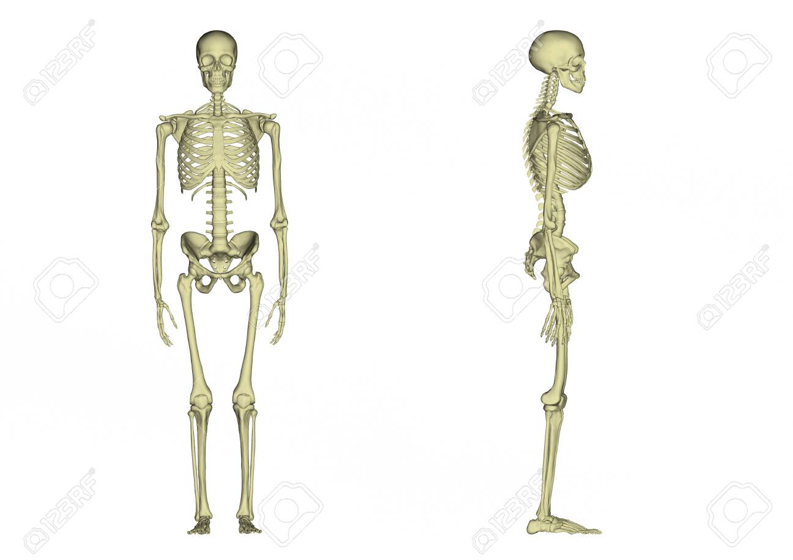
There are two major jobs for the skeleton to do. The first is to construct a skeleton around the vital organs to keep them safe. The cranium shields the brain, the ribcage the heart and lungs, and the pelvis a measure of safety for the digestive organs. One of its principal uses is for movement or mobility.
Some bones in the body provide other functions, such as producing blood cells and bone marrow, in addition to those associated with movement and defence.
There are 206 bones in the human body (although some textbooks may indicate more since they include bones present at birth but subsequently fused). The composition of a bone is 25% water, 30% organic stuff, and 45% mineral, making it essentially a dry, thick tissue. The mineral composition of the bone is mostly composed of calcium phosphate, with a trace amount of magnesium adding to the bone’s hardness. A portion of the organic material that gives the bone its strength and integrity is included inside this.
Bones may be broken down into five distinct categories:
Long Bones: Femurs are the longest and strongest of the long bones. In most cases, this will include the periosteum, a thick covering that sits above a spongy layer surrounding the bone marrow.
Short Bones: The metatarsal bones in your foot are among the shortest in the body.
Flat Bones: There are some bones that are quite flat, such as the frontal skull bones.
Irregular Bones: Vertebrae are an example of the body’s irregular skeleton.
Sesamoid bones: these bones are the fatty, spherical bumps in tendons. The patella, or kneecap, is a typical instance of such a structure.
Some bone components:
The epiphysis, or terminal end of a long bone, is one of the bone’s components.
The diaphysis is the bony part that extends from the thigh to the knee. This structure has a central hollow and is formed of compact bone.
Cartilage in the hyaline or articular layer is slick and smooth, and it has a bluish-grey colour. Synovial fluid prevents it from drying out. The bones are joined together by this.
The periosteum is a connective tissue covering that nourishes the bone from the blood supply.
Bone marrow, or red marrow, is densely packed inside of a bone. It’s really small strands of bone that have developed through. It aids in the correction of poor posture and in bearing the body’s weight and stressors. The medullar cavity hollows out the bone to make room for the marrow. Blood cells are produced in the bone marrow throughout infancy, but that process stops as you get older, and the void is filled with yellow fat.
It is compact bone that makes up the inside of the diaphysis. The bone is stacked in concentric layers to create this. This has “canals” built right into it, which the blood flows through. By passing through the medullary cavity, blood is able to branch out and nourish the rest of the bone. Bone growth occurs in stages, beginning at the epiphysis and continuing along the diaphysis till finally reaching the cartilage at the extremities of the skeleton. The meeting point of two bones is called a joint. Three distinct joints exist. No motion is possible at all in a synathrosis, often known as a fixed joint. Joints between the sutures of the skull, for instance, look like this. There is fibrous tissue in between the bones, and the bones may overlap or have jagged edges.
Amphiathroses are a kind of joint that is only marginally mobile. Think about the sacroiliac joint in your pelvis and the ends of your clavicle. Extremely lengthy ligaments bind these joints together, and thin fibrocartilage cushions keep them apart (cartilaginous joints). Most joints with full range of motion are enclosed in a fibrous capsule. Synovial fluid, which has a consistency similar to egg white, surrounds and lubricates these moving parts. Hyaline cartilage covers the bone surface and makes it smooth. The knee is the only hinged joint that allows for full range of motion. To prevent hyperextension, the kneecap acts as a type of doorstop. If the patella is fractured, for example, the whole lower leg will go forward.
Mucous bursae are tiny pockets of clear liquid found within this fibrous capsule. These provide cushioning for the joint. Synovitis, also known as tennis elbow, and bursitis, sometimes known as the housemaid’s knee, both occur when the fluid in these pockets becomes inflamed through repeated usage or age. How therefore will we account for the missing 206 skeletons? The skull is an incredibly complex structure, made up of 22 bones (8 of which are cranial bones).
There is one less frontal bone on the forehead.
The top and sides of the skull are made up of two bones called parietals.
One of the bones at the back of the skull, the occipital bone, is shaped like a saucer.
Two temporal bones, located on each side of the skull at its base.
Just above the temporal bone lies the sphenoid, an unpaired bone that looks a little like a butterfly.
It is the ethmoid bone that divides the nasal cavity from the brain.
14 bones make up the face. The most important of them are the following:
The upper jaw, also called the superior maxilla, is the part of the mouth that covers the roof of the mouth.
Mandible, or the lower jaw
The two zygomatic bones in each cheek, the two nasal bones that together form the nose
Two lachrymal bones in each tear duct. The orbit of the eye is where you’ll find them.
Inscription on the skeleton:
There are 25 bones in the thorax (chest) of a human body:
This is the sternum or breastbone.
A human body has 12 sets of ribs. In humans, only the first seven sets of ribs are considered “real ribs” because of their full fusion with the sternum. False ribs are what fill up the gaps. Eighth, ninth, and tenth ribs join with the rib above them, whereas the eleventh and twelfth float alone.
There are 33 bones in the spine, and they are as follows:
There are 30 vertebrae in all, 24 of which are genuine or moveable vertebrae that are separated by pads of fibrocartilage and 9 fixed or false vertebrae that are tightly bonded together and have no cartilage between them.
Moving along the spine, we find:
There are seven cervical vertebrae; the atlas is the first and the axis is the second.
The thoracic (chest) region has 12 vertebrae; the lumbar region has 5; the sacral region has 5; and the vertebrae in the sacrum are fused together to create the sacrum.
And last, the coccyx is made up of the four coccygeal vertebrae.
There are four bones in the shoulder girdle:
Two collar bones (clavicles)
Two shoulder blades (scapulae).
There are a total of 30 bones in each arm, making the upper limbs a total of 60:
Humerus refers to the bone in the upper arm.
Forearm’s most distal bone is called the radius.
Ulna refers to the inner forearm bone.
The 8 carpal bones in your wrist are responsible for articulating your hand.
The five metacarpals are the hand’s main bones.
The bones of the fingers, known as phalanges, number 14.
The pelvis consists of 2 bones:
The innominate bones are the hip bones on both the left and right sides of the body. There are three components to each of them. the pubis, ischium, and ilium
The coccyx and sacrum were previously discussed.
Again, there are a total of 60 bones in the legs and feet.
The femur is the medical term for the thighbone.
What we’ve been calling the kneecap is really called the patella.
The tibia is another name for the shinbone.
In addition, the fibula, often known as the brooch bone, serves as the calf bone.
There are seven tarsal bones in the ankle.
The foot has bones called metatarsals.
Phalanges are the bones that make up the toes.
Those of you who are good with numbers will realise that there is a missing bone. Followers of police procedurals will be familiar with the hyoid bone. Since it is not attached to the skeleton, it is listed independently. This muscle, located in the upper neck, helps keep the tongue and other breathing apparatus in place, enabling humans to communicate. Correct alignment of the skeleton, and especially the spine, is of utmost significance in health since every neuron in the body, with the exception of the sinuses, goes via the vertebrae. When we look at the holistic method, we’ll go into more depth on this topic.










 Google